
New Metadata Standards:
Are You Prepared?
Over the last few weeks, I’ve been untangling a problem for one of my clients - they wrote a track with two collaborators who aren't registered with any society. That means no IPI/CAE. It also means we can't get the work properly registered because the ISWC gets stuck in limbo. On its own, it’s a familiar headache, but sitting next to what's happening in the UK and the EU right now, it started to feel less like a one-off and more like a preview of where things are heading.
So let me connect those dots, because all my preaching about “prevention over reaction” is about to be reality.
The patch-it-later habit is quietly becoming a liability
One of the toughest shifts for me, when I moved from catalog to front-line releases in 2009, was how often label copy didn’t have confirmed writer and publisher information at time of release. We’d still be wrangling splits and confirming ownership months after the release was out the door. The identifiers get backfilled once things trickle in. The industry has gotten into the habit of treating delivery as the start of the paperwork rather than the finish line, and the systems around us mostly let us get away with it.
That grace period is closing.
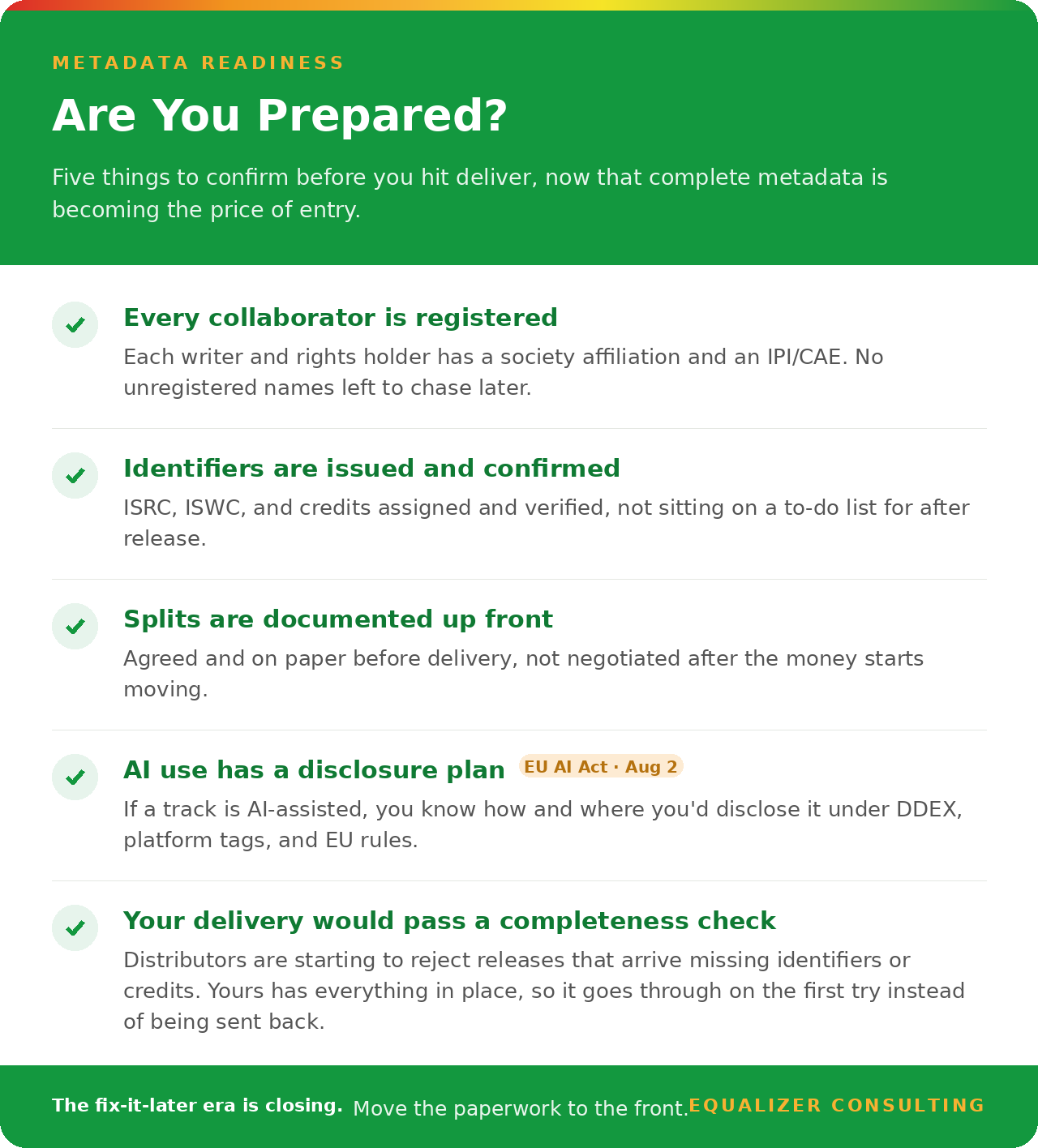
The UK Music Metadata Agreement is worth paying attention to even if you never release a note in the UK. The agreement raises the bar on what “delivered” actually means. Identifiers like ISRC, ISWC, and IPI/CAE, along with full credits, are now expected to be complete at the point of delivery, not supplied afterward.
Tripping over the acronyms? Our glossary has them all in plain language.
Need a split sheet? Generate one here.
The part that could genuinely change behavior: distributors may begin rejecting incomplete deliveries outright rather than waving them through and sorting it out downstream. Read that in the context of my client. If the delivery had to be complete on day one, those two unregistered collaborators wouldn't be a slow-motion cleanup project, they'd be a hard stop on the release.
Why a decision in one territory matters everywhere
It's tempting to file the UK news under “not my problem” but I'd gently push back on that. Territories don't set standards in isolation anymore, and the ones who move first tend to set the reference point everyone else drifts toward. When a major market decides that complete metadata is the price of entry, distributors and platforms that operate globally don't usually build one workflow for the UK and a looser one for everyone else. It's far easier to raise the floor across the board.
What starts as a regional agreement has a way of becoming the quiet global default. It's the same pattern that turned GDPR, a European privacy regulation, into the privacy baseline companies now apply worldwide.
That's the groundwork being laid right now, and it's happening on two fronts at once.
The AI disclosure layer is arriving on the same timeline
The second front is AI. I’ve been telling my musicians clients and students for some time that they should consider making note of any generative AI that they use, because they may be asked to show the receipts.
The DDEX AI disclosure framework is going live, though it's still voluntary. The platforms are building on top of it: Spotify launched its AI Credits system in April, designed to surface disclosure without penalizing AI-assisted tracks, and Apple Music followed with AI Transparency Tags in March. On paper, that's progress toward a standard. In practice, this week's reporting flagged that the rules remain voluntary and incomplete, and the self-reporting gaps are already being exploited by fraud actors. When disclosure is optional and enforcement is thin, the people willing to game it move first.
Meanwhile, The EU AI Act, Article 50, becomes enforceable on August 2. Transparency obligations for AI-generated audio and deepfakes turn into hard law across all 27 member states. That's not a framework anyone can opt out of, and like the UK agreement, its reach won't stay inside its borders. Once labels and distributors have to tag AI content to satisfy the EU, that tagging discipline ripples into how they handle content everywhere.
Put the three together and the direction is hard to miss: metadata that used to be optional, deferrable, or self-policed is becoming required, upfront, and enforced. The voluntary era and the fix-it-later era are ending at roughly the same moment.
When “we'll sort it out after release” stops working
This is where my client's situation stops being an anecdote and starts being a warning. Two collaborators without society registration might sound like a minor administrative gap. Under the standards taking shape, it's the kind of gap that could block a release, strand royalties, or flag a track for the wrong kind of scrutiny.
Getting identifiers issued isn't fast. Society registration, IPI assignment, work registration, and ISWC issuance all move on their own timelines, and none of them care about your release date. The preparation for release to make sure all of the right pieces are in place must now be built into the delivery timeline.
None of this requires panic. It requires a shift in when the work happens. The same tasks we've always deferred simply need to move to the front of the process, with a sufficient buffer built in to ensure that you have time to wait on third parties (such as PROs) to handle their piece.
So, are you prepared?
For years, the broken pieces of our metadata systems were absorbed quietly downstream - with unallocated royalties being pushed into black box royalty pools, and the cost of getting it wrong primarily affecting the people least equipped to know how to navigate the systems to fix it.
I don't think we're at the finish line on any of this. The AI standards are still half-built, and the enforcement details will keep shifting for a while. But the groundwork is being poured in the UK and the EU right now, and it's pointing in one direction. The question I'd leave you with isn't whether these standards are coming. It's whether the version of you that hits deliver on your next release will be ready for them.
Getting ahead of these standards is exactly the kind of groundwork I help clients build, before a rejected delivery or a stranded royalty forces the issue. If you want to put a strategy in place that has you ready for what's coming, let's talk.